Since I moved to Vienna
(which happened pretty recently), I have been fascinated by Austrian
history more than ever. Vienna oozes the wealth of its wonderful
past. Cultural heritage is not only the architecture and art, it is
also the persons who made history. One of the most famous and
probably one of the most eccentric Austrians must be Marie
Antoinette, the Queen of France, Dauphine, style icon or
l'Autrichienne.
Reluctantly she had to
leave her beloved Vienna for rigid Versaille to correct strained
relations between Austria and France. But before Marie entered
France, she underwent a total makeover to look more like a francaise.
French stylists worked on her attitude and appearance and royal
inspection service has stripped her of all Austrian dresses and
belongings of sentimental value. Marie had to forget her fatherland
and start her life all over again according to the etiquette of
Versailles.
Adapting to the new rules
was not so easy. She was continuously judged, examined and supervised
by an entourage at the most awkward moments like her wedding night or
bathing. In addition she was put under pressure to give birth to a
successor to the throne. While Marie was not allowed to express her
feelings, she began to develop her own recognizable style which
inspires and fascinates to this day.
Marie tried to break with
royal rules and traditions. For example, she refused to wear a corset
and rode horses like a man, and wore male costumes. That gave her
strength and sovereignty. Louis XIV and Catherine the Great also
expressed their dominance and superiority with their self-portrait on
the horse. The royal court however was not thrilled with Maries
disrespectful feminist behavior and threatened to send her back to
Austria. That would be a blunder and a disappointment.

In Vienna Marie wore a
more flexible corset, the french one was a torture device and caused
huge disorders. Women suffered from frequent faintings, difficulties
with breathing and digesting food, not to mention heart palpitation,
asthma, vapors, stinking breath, consumption and withering
rottenness. Marie however didn't really suffer, she only felt basic
discomfort. Regardless to her liberating anti corset statement, the royal court experienced it more as a taboo. France was not ready for strong
female figures after a long history of promiscuous kings en their
modest wives.
Marie did not intend to
devote her life to religion and children. She became the most
fashionable woman in France. With Rose Bertin on her side, she showed
Paris the most expensive dresses and the most oversized poufs. Unlike
the previous queens, Marie looked for publicity and became a true
diva and a royal court's supermodel. Her passion for fashion was a
important distraction from the daily worries.
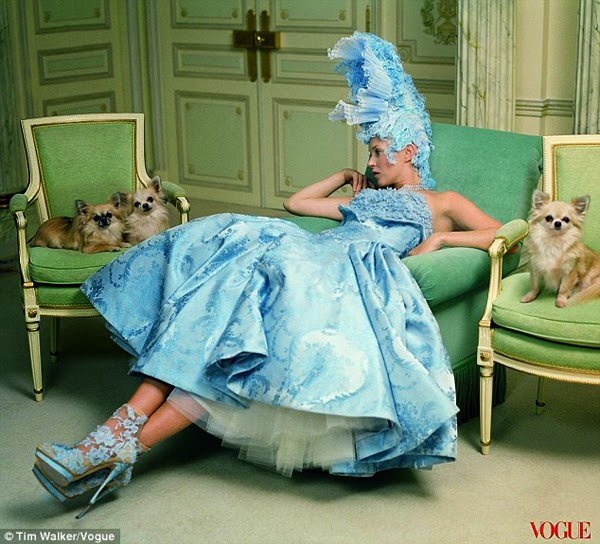
The most distinctive
aspect of Maries appearance was obviously the pouf. It was copied as
often as ridiculed in the media. The hairstyles were not only
ridiculously high, but also very uncomfortable. The top was decorated
with eg feathers, flowers and fruit and the inside was filled with
fake hair, bobby pins, grease and perhaps even more. Sleeping
horizontally was impossible, dancing and traveling was restricted,
the front seats at the opera were prohibited and vermin caused much
itching. Solution was found for only the latter problem: a special
scraper made of ivory, gold or silver and sometimes even decorated
with diamonds.
The excessive costs of
Marie's lifestyle didn't charm the poor nation. Just like the
criticism about hunger and poverty in France didn't stop Marie from
spending even more. The monarchy lost it's superiority and popularity
while the revolutionaries seized power. Brutal and violent French
revolution abolished the Ancient Regime and sentenced Marie and her
husband to the guillotine.
Despite this fatal end
Marie Antoinette is never forgotten. In fact her style now is even
more relevant than ever and inspires the biggest fashion designers,
movie makers and artists.